We talk about fear of the unknown as though the unknown were the problem. I am not convinced that it is.
I have spent a good deal of my life standing at the edge of water I could not see across, and rather more of it lately standing at the edge of businesses I had no idea how to build. In neither case was the thing frightening me a gap in my information. It was a more personal question, and it went roughly like this: will I be enough for whatever is in there?
Ask a room full of experienced people what they are afraid of and they will name real things, and mean them: the market, the technology, the workload, the exhaustion of beginning again at this stage of a career. They are not wrong, exactly. They are describing the surface of something they have had no particular reason to look underneath. What is actually being protected is the version of themselves that currently works - the competence they have spent years building, the thing they are reliably excellent at, the reason they have a seat at the table. The unknown is frightening precisely because it is the one place that competence might not count.
So we stay where our expertise still applies. It is a reasonable instinct, but it quietly costs us a great deal, because real transformation asks you to be, for a while, someone you have not yet learned how to be.
Visualising the outcome does almost nothing
The standard advice at this point is to visualise. Picture the finish. See yourself on the podium, signing the contract, the audience on its feet.
I have never believed in this, and I have come to think it is a lazy instruction dressed up as a technique.
That instinct turns out to be well founded. Imagining a successful outcome, on its own, tends to reduce the energy people bring to actually pursuing it; the fantasy pays out a small instalment of the reward and the system relaxes. But there is a simpler problem with it. When you picture yourself on a podium, you are in the audience. You are watching a stranger who happens to look like you. Nothing about that image tells you anything you can use on a Tuesday morning when the work is dull and nobody is clapping.
The thing you cannot picture
And then there is the version of this problem that visualisation cannot touch at all. That is the one that taught me the most.
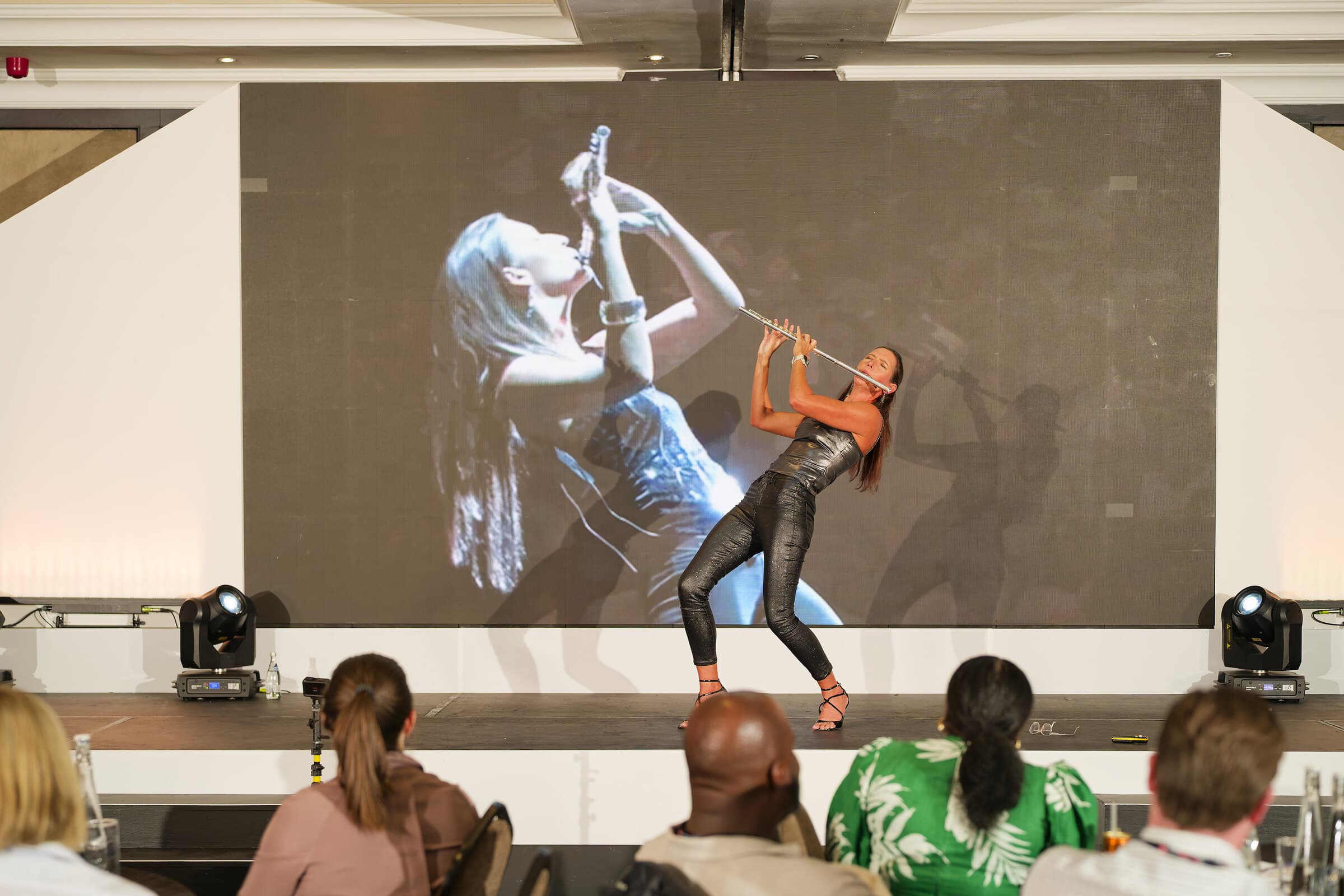
I trained as a classical flautist. I spent my childhood and a good part of my twenties mastering an instrument that is, by design, delicate. It is built for air and precision and it is extremely good at being what it is. My difficulty was that I did not want what it was good at. I wanted a sound it had not been built to make: something with the weight and the distortion and the raw emotional power of an electric guitar, which is the polar opposite of the flute if ever there was one.
There was Jethro Tull, but that sat a long way left of what I had in mind. I wanted something that still pierced the listener through melody, the way the flute always has, while carrying a power and an attitude the instrument simply did not have. Nobody had made that sound. I could not picture the outcome, because the outcome did not exist anywhere for me to picture: not on a stage, not on a record, not in anybody else's hands.
What I could do, oddly, was imagine the person who would be making that sound. How she would stand. What she would be prepared to risk sounding like in front of people, before anybody knew whether the result would be ridiculous or extraordinary. What she would have stopped caring about. And what she would have given to find out what that sound felt like.
So that is who I practised being, for years, while I did everything I could think of to that instrument - and a great deal that I could not have thought of when I started.
I would not have had a name for this at the time. I have one now.
Future memory
The move is not to imagine the achievement. It is to imagine the person, from the inside, in detail vivid enough to be visceral, until she stops being an aspiration and becomes somebody you have met.
Not from the outside, though. From inside her. What does she notice first when she walks into a room? What does she do with the kind of setback that would currently make me walk away? How does she speak when she is under pressure, what does she decline, what does she find straightforward that I still find hard?
I have come to think of this as building a future memory, and the contradiction in the phrase is the whole point. You do not visualise a memory. You have one. A memory carries something an image never does, which is familiarity - it feels like a thing that happened to you, and you behave accordingly.
Musicians understand this instinctively, although we use a duller word for it. We do not visualise a performance; we rehearse one, over and over, until the hands know it and the nerves have somewhere to go. A future memory is the same operation performed on a person rather than a piece of music.
Visualisation says: I can see myself reaching the other side.
A future memory says: I know what it is like to be the woman who reaches the other side.
This is not a new idea so much as a badly under-used one. Psychologists have been studying possible selves for forty years - the future identities we carry around with us and the way they shape what we do today. What the research suggests, and what my own experience insists on rather more loudly, is that a future self you have genuinely inhabited behaves quite differently in your head from one you have merely admired and coveted.
A picture cannot answer a question
Here is the practical difference.
If all you have is an image of the outcome, then every decision between here and there has to be reasoned out from first principles. That is exhausting, and almost impossible to sustain. If you have a future memory, you have something far more useful: a test you can apply in about two seconds. Not what should I do, which is a genuinely hard question, but what would she do, which is usually an easy one.
That test works on small things, and small things are what transformation is actually made of. She would get in the water. She would send the difficult email rather than rewrite it a third time. She would say no to the work that keeps her good at what she is already good at, and yes to failing again on the way to a success she is certain exists and is curious to see what it is wearing. You find that you already know the answers, because you have met her.
Crazy confidence
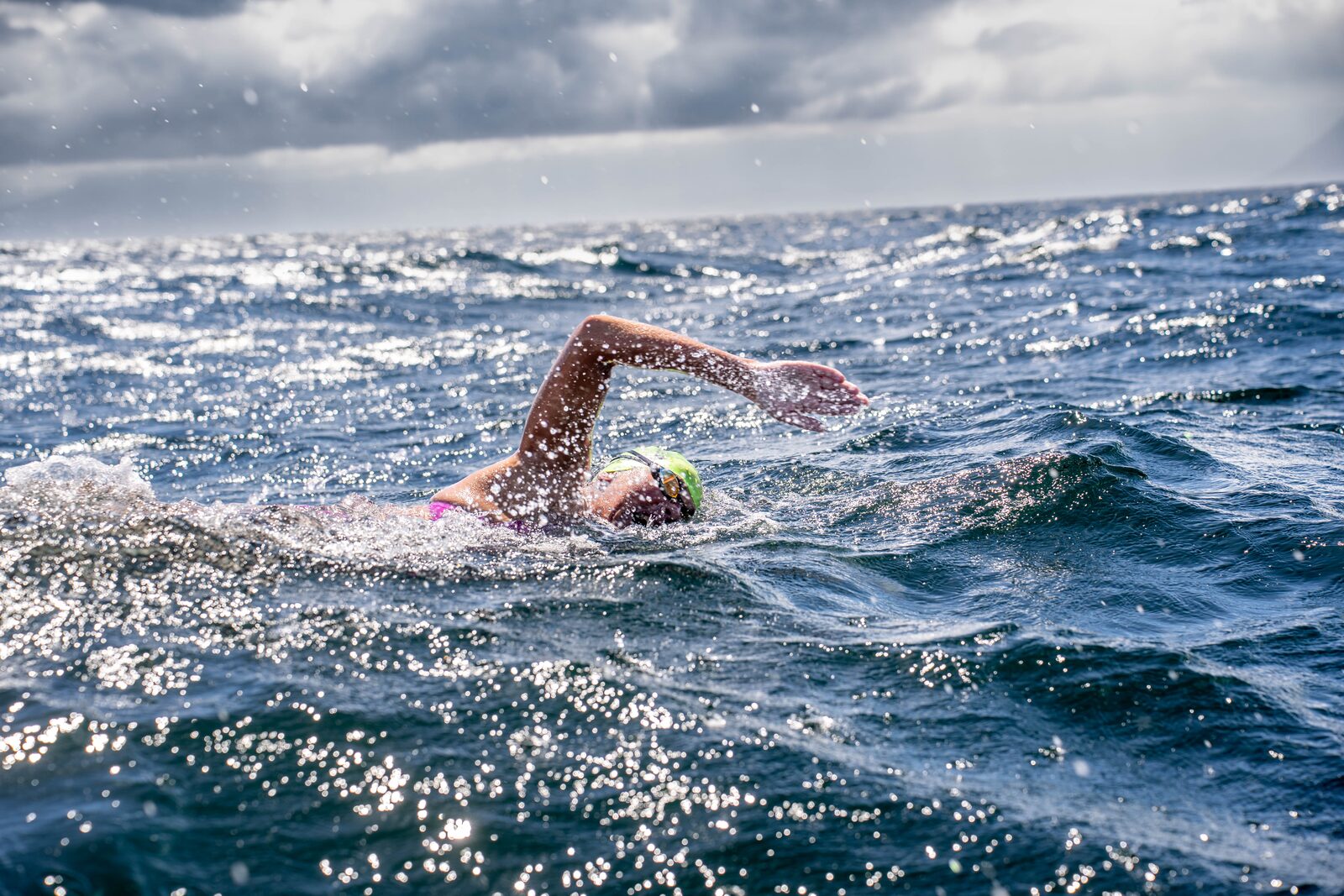
Somewhere in this process something happens that I have never been able to explain to anybody's satisfaction, including my own. I call it crazy confidence, for want of anything better.
I have committed to swims that bore no sensible relationship to anything I had done before. Some of them had been attempted by dozens of people, almost all of whom had failed, several of them stronger swimmers than I was. Some of them nobody had attempted at all. I had no evidence. I could not have told you how I intended to do it.
But I was not hoping, and that is the part that is difficult to convey. I did not know that I would make it. I could not rule out failure, and I did not try to. What I knew was what I was going to do, and I trusted that doing it would not leave me where I was standing. That is growth. Often enough, it is also success.
It is worth being precise about what this is, because we have a woolly vocabulary for it. Self-belief is an acknowledgement that something is possible. Expectation is a forecast: this will happen. Conviction is neither. Conviction says I will do everything within my power to make this happen, and it is the only one of the three that does not depend on the world cooperating.
Certainty about the world is not available to anybody. Certainty about your own commitment is entirely available, and it turns out to be the one that does the work.
Why the crazy confidence is not actually crazy
I was wary of this for years, because it looks irrational and I am not, on the whole, an irrational person.
The clearest case I have has nothing to do with water. It comes from building a business.
Some years ago I set out to build an online marketplace for the events industry, an Airbnb for a business I had worked in for more than fifteen years. I was ready to disrupt my own company and my own industry, and I was certain it would work, because I had spent fifteen years learning precisely what was broken in the traditional model. The vision was clear and it was exciting.
Two million rand later I had something that technically functioned and that I was quietly embarrassed by. It worked. It was not what I had seen. I knew exactly what it still needed; what I did not have was the money to build it, and the economics of my industry made that gap unbridgeable. Even I had to concede the point. So I lost interest, which is a polite way of saying that I failed.
That is evidence. Expensive, documented, first-hand evidence that this thing was not meant to be built.
I rebuilt it myself this year. Four months, using AI, having never written a line of code in my life. It is live, it carries real transactions, and there are several hundred vendors on it. What was not meant to be built was built in four months, by somebody who cannot code. It went on to win the technology category at the Womandla Women in STEAM Awards.


A prediction, properly made, would have told me not to attempt that. The evidence was in and it pointed one way. But a conviction is not a prediction, and that distinction is the whole answer to the charge of irrationality.
A prediction is a claim about what will happen, and a prediction with no supporting evidence is indeed foolish - it is a guess dressed up as knowledge, and reality corrects it in due course. A conviction is a statement of what you intend to do. Predictions can be wrong. Intentions cannot be wrong in that sense; they can only be kept or abandoned, and both of those are yours. Which means that the part of this that looks least rational is in fact the only part entirely within your control.
It is also load-bearing. Without it there is no particular reason to do the preparation, and the preparation is what makes the outcome possible at all. The conviction does not make you succeed. It makes you train.
Discipline is where it stops being a thought
Everything above is still, at this point, happening inside your head.
Imagination gives you somewhere to go. Conviction gives you a reason to go. Discipline is the only thing that actually moves you, and it is by some distance the least romantic part of this. It is early alarms. It is painful shoulders. It is the hundredth version of something nobody will ever hear. It is committing to better when good enough is already on the table.
But something accumulates while you are doing it, and it isn't only fitness or competence. Every promise you keep to yourself when it would have been easier not to, becomes a piece of evidence - not evidence that you will succeed, because you still don't know that, but evidence that you are someone who does what the conviction requires. After enough of it, you stop needing to know how the story ends before you are willing to begin it.
Discipline allows us to trust the unknown because it teaches us to trust ourselves.
Becoming before achieving
I think we have the order wrong.
We behave as though achievement comes first and identity follows along afterwards: that you earn the right to feel capable by having already been capable, that confidence is a reward for success rather than a condition of attempting it. So we wait. We wait for the proof before we will allow ourselves the title.
But it runs the other way. You build the memory first. You start making her decisions instead of your own. And at some point, with no announcement and usually no ceremony, the decisions stop being an impersonation.
None of this is positive thinking, and none of it is pretending. The distance between where you are and where she is remains exactly as long as it was. Nothing here makes the swim shorter, or the water warmer, or the instrument easier to play, or the business easier to build. What changes is that you now know who is doing it.
You do not have to know how. You have to know who.
Bring Carina to your stage.